
Elütriasyon Rotorları
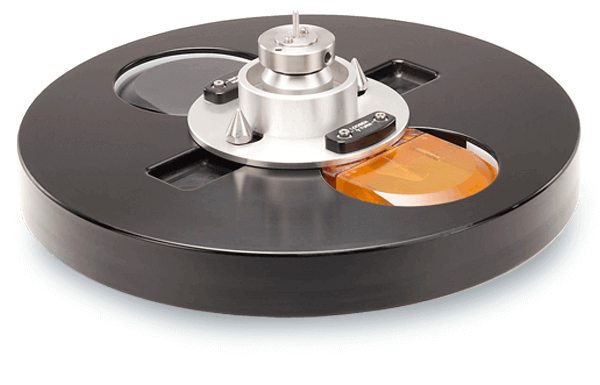
Elütriasyon rotoru, tekli hücrelerin veya partiküllerin (yaklaşık 2 ilâ 50 μm çapında) monodispers (tekil dağılımlı) süspansiyonlarını boyuta göre ayırmak ve/veya konsantre etmek için tasarlanmıştır. Bir elütriasyon rotoru iki ayırma teknolojisini birleştirir ve haznelerde yer alan her bir hücre iki karşı kuvvetle işleme tabi tutulur:
- Santrifüj kuvveti: Dönüş ekseninden uzağa doğru hareket ettirir. Bu, bir santrifüj kuvvet alanının etkisi altında çökme sürecidir.
- Sıvı hızı: Rotasyon eksenine doğru hareket ettirme —“karşı akış elütriasyonu.” Bu, yıkamayla ayırma işlemidir.
Ayırma, huni şeklinde bir elütriasyon haznesinde gerçekleşir. Rotor santrifüjde dönerken, hücre süspansiyonu santrifüjün dışından rotor içerisine ve elütriasyon haznesinin dar ucuna doğru önceden ayarlanmış bir akış hızında pompalanır. Hazneye süspansiyon hücreleri girdikçe, çökme hızlarına göre üzerlerinde etkili olan iki kuvvetin etkilerinin dengelendiği gradiyentteki konumlara geçerler.
Çökme hızları düşük olan küçük hücreler hızla rotasyon eksenine doğru yıkanır. Bu hücreler hazne dışarısına doğru, rotor içerisinden yukarıya ve bir toplama kabı içerisine girecek şekilde yıkanır. Biraz daha büyük veya daha yoğun olan hücreler hazne içerisinde daha yavaş hareket eder ve elütriasyon sınırında dengeye ulaşır. En büyük veya en yoğun hücreler, santrifüj kuvvetinin ve sıvı hızının yüksek olduğu hazne girişine yakın bir noktada kalırlar. Kademeli olarak akış hızını artırarak, gittikçe daha büyük veya yoğun hücrelerin ardışık fraksiyonları rotor dışına doğru yıkanarak çıkarılabilir ve toplanabilir. Akış hızının kademeli artışının devam etmesi sonunda tüm hücreleri hazneden yıkayarak dışarı atar.
Yeni Intellifuge Calculator’u [Hesaplayıcı] çalışırken görmek için buraya tıklayın.
FAQ on Elutriation Rotors
How does an elutriation rotor work?
An elutriation rotor contains a specialized chamber in which cells are exposed to opposing centrifugal and fluid-flow forces. Smaller cells are carried out of the chamber more readily, while larger or denser cells remain until flow conditions change. This enables sequential collection of distinct cell populations.
What is counterflow centrifugal elutriation?
Counterflow centrifugal elutriation is a separation method in which fluid is pumped toward the center of a spinning rotor while centrifugal force drives particles outward. The balance between these opposing forces allows cells to be separated according to size and sedimentation behavior.
How are cells separated during centrifugal elutriation?
During centrifugal elutriation, cells are exposed to two opposing forces: centrifugal force, which drives cells away from the axis of rotation, and fluid flow, which pushes them in the opposite direction. Cells separate according to their size and sedimentation behavior. Smaller cells are elutriated first, while larger or denser cells remain in the chamber until higher flow rates are applied.
What is elutriation?
Elutriation is a separation technique that uses opposing fluid flow and centrifugal force to separate particles or cells according to their size and sedimentation properties. Unlike pelleting-based methods, elutriation enables continuous fractionation of cell populations while helping maintain cell viability.
What is centrifugal elutriation?
Centrifugal elutriation is a laboratory technique that combines centrifugation and controlled fluid flow within an elutriation chamber. Cells or particles separate based on their size and sedimentation rate as fluid moves against the centrifugal field.
What applications are elutriation rotors commonly used for?
Elutriation rotors are commonly used for cell fractionation, immune cell isolation, stem cell research, cell enrichment, cell therapy development, and other applications requiring gentle separation of viable cells.
What is the difference between elutriation and conventional centrifugation?
Conventional centrifugation typically separates particles by pelleting them within a tube. Elutriation separates cells continuously using opposing fluid flow and centrifugal force, enabling collection of distinct populations while minimizing cell stress and supporting higher cell viability.
What are the advantages of centrifugal elutriation?
Centrifugal elutriation can support gentle cell processing, high recovery rates, scalable workflows, and reproducible fractionation of cell populations. It is commonly used when viable cells must be isolated without labeling or extensive sample manipulation.
Why is elutriation used for cell separation?
Elutriation enables label-free separation of viable cells based on physical properties such as size and sedimentation rate. This makes it useful for applications where maintaining cell integrity and functionality is important.
